
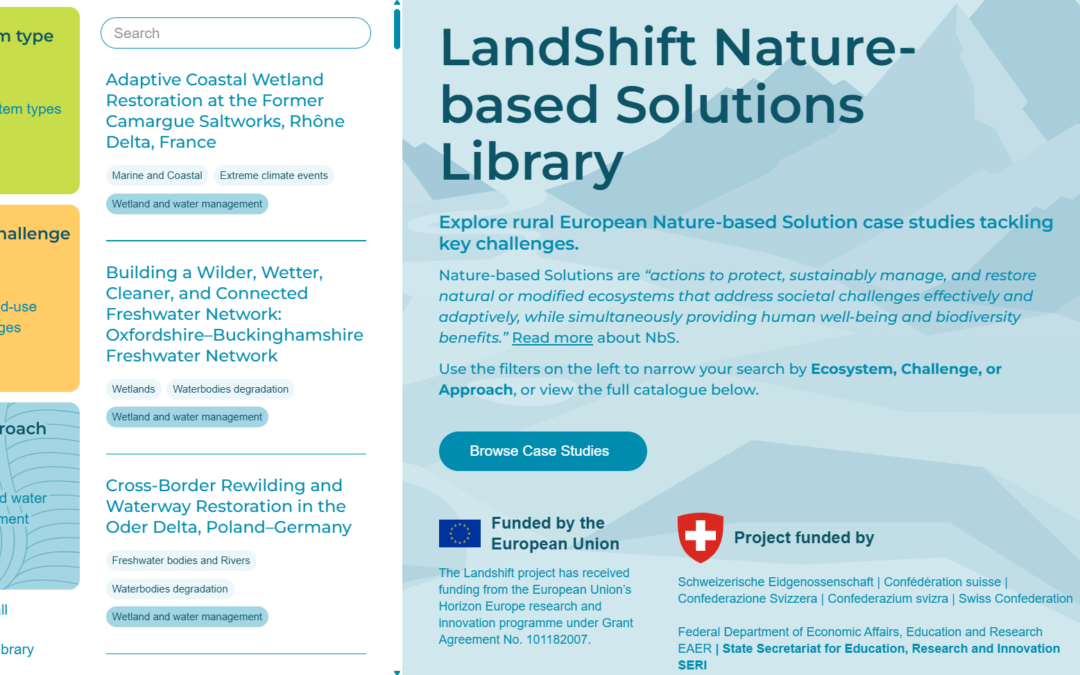
LandShift is proud to announce the launch of its Nature-Based Solutions (NbS) Library, an open-access digital repository of implemented European nature-based solutions designed to support regional land-use strategy development. Sixteen months into the project, this milestone marks an important step in translating LandShift’s analytical work into practical, deployable action.
This critical task has been undertaken by a dedicated team from the the core LandShift partner Metabolic Institute working at the intersection of academic research and real-world experimentation.
Why this matters now
Europe’s climate and biodiversity ambitions are clear. Delivering them, however, depends not only on targets and regulatory frameworks, but on the availability of concrete, tested solutions that can be realistically deployed across diverse regional contexts. As Member States work to meet commitments under the revised LULUCF Regulation and related climate and nature restoration policies, the central challenge lies in moving from strategic objectives to implementable action on the ground.
Nature-based solutions offer a powerful pathway forward. As defined by the European Commission, they are actions to protect, manage, and restore ecosystems in ways that are grounded in nature and designed to generate environmental, social, and economic benefits. Whether through restorative agricultural practices, wetland restoration, or landscape-level ecosystem management, NbS can simultaneously contribute to carbon sequestration, biodiversity recovery, food system resilience, and rural development.
Yet despite their recognised potential, the application of NbS often remains fragmented. Policymakers and regional planners face constraints related to evidence, transferability, feasibility, and alignment with local conditions. What works in one region cannot simply be replicated in another without understanding its ecological, socio-economic, and governance context.
The LandShift NbS Library was created precisely to address this implementation gap.
What is the LandShift NbS Library
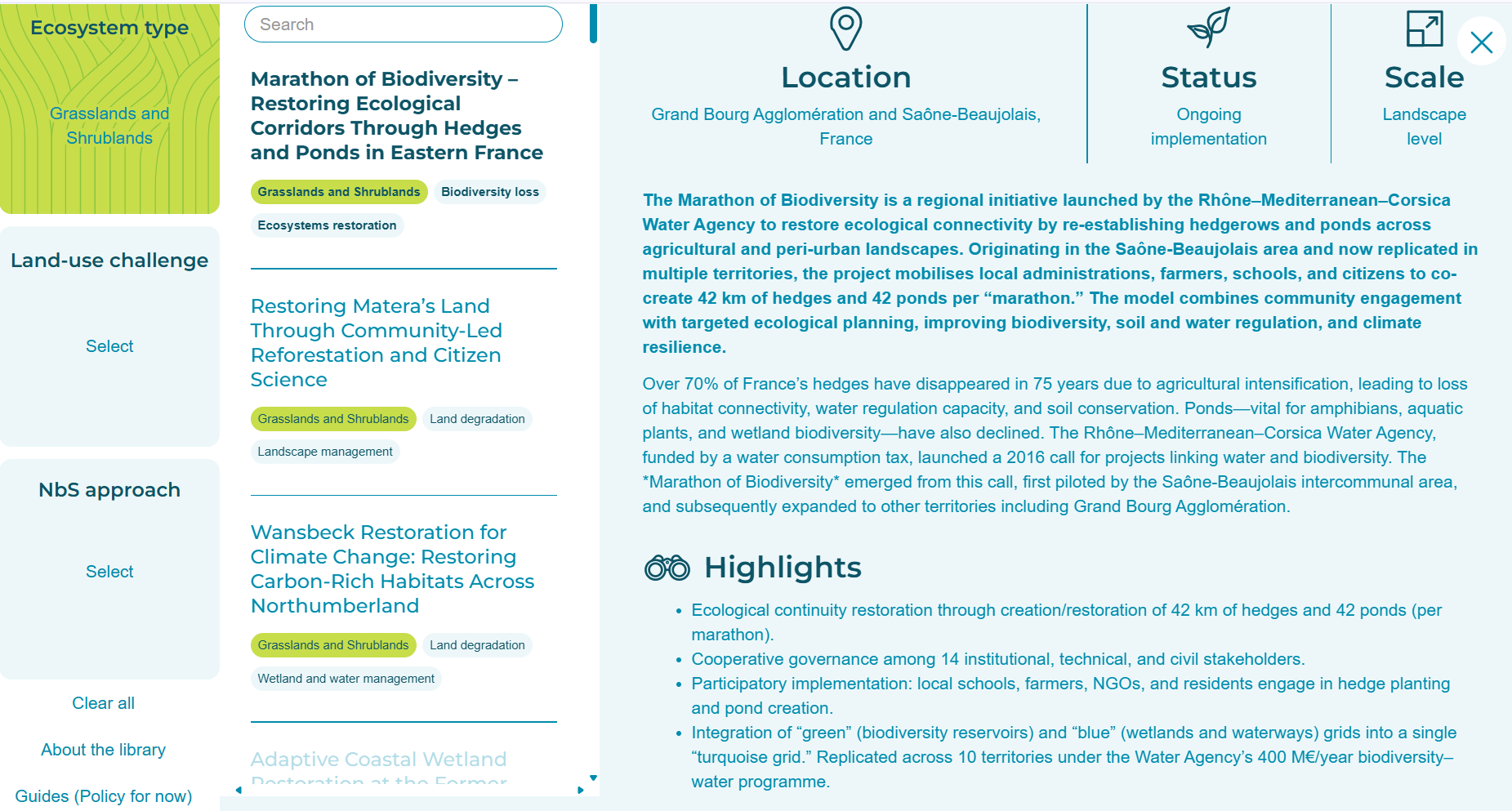
The LandShift NbS Library is far more than a compilation of scientific work. It is an interactive digital collection built on the systematic identification and rigorous curation of implemented NbS cases across Europe. Each case is classified by ecosystem type, land-use challenge, and NbS approach, enabling users to conduct targeted searches and strategic comparisons.
Within the LandShift project, the NbS Library plays a fundamental role, as Antoine Coudard, Bioeconomy Lead at Metabolic Institute, explains:
“The Nature-Based Solutions Library is designed as a practical resource for the five LandShift Living Spaces as they develop their future territorial land-use strategies. Its core function is to provide concrete examples of implemented nature-based solutions that regions can draw inspiration from when identifying and selecting interventions for deployment. While LandShift analyses land-use change, climate impacts, and future scenarios, the Library supports the next step: translating these insights into actionable options. It offers a structured set of real-world solutions that regional stakeholders can consider, adapt, and integrate into their climate-resilient land-use strategies.”
The Library was developed through close dialogue with representatives from the Living Spaces, ensuring that it directly responds to the concrete challenges faced in these regions and their respective ecosystems. The case studies featured address land degradation, biodiversity loss, and degradation of water bodies, as well as challenges related to climate extremes, urbanisation pressures, an other context-specific issues.
What makes the LandShift NbS Library unique
Over the past decade, numerous NbS databases and knowledge hubs have emerged. The LandShift NbS Library distinguishes itself in three key ways:
- Focus on implemented cases rather than conceptual or early-stage pilots
- European relevance, ensuring transferability to EU land-use planning contexts
- Structured curation, allowing users to filter solutions by ecosystem, challenge, and approach
As Antoine highlights:
“Many existing NbS platforms include conceptual approaches, early-stage pilots, or global examples that may not be directly transferable to European land-use planning contexts. The cases featured here go beyond theory and small-scale pilots. They represent interventions that have already been implemented and can offer tangible lessons for regional decision-makers. By concentrating on European experiences, the Library increases relevance, transferability, and policy alignment.”
Besides that, the many libraries that exist all focus on different purposes and vary depending on context, geography, how and for whom they were curated, and thematic focus, which further underscores the need for an NbS library tailored to the LandShift project. By focusing on European contexts, this library strengthens its practical value and ensures closer alignment with regional planning needs and EU policy frameworks. A clear example of this approach is its planned integration of the principles of the New European Bauhaus (NEB), an initiative launched by the European Commission with the goal of making the green transition sustainable, inclusive, and beautiful. As Antoine notes:
“In future editions, it will also integrate principles of the New European Bauhaus, creating one of the first structured bridges between environmental performance, social inclusion, and aesthetic quality within a nature-based solutions platform.”
Designed for real-world use
The NbS Library is designed as an open, user-friendly exploration tool. It eliminates the need to navigate extensive academic literature by providing accessible, curated examples grounded in documented experience.
Regional authorities, planners, and local stakeholders can use it during strategy development and stakeholder discussions to:
- Compare approaches implemented elsewhere in Europe
- Identify solutions relevant to specific land-use challenges
- Ground decisions in documented, real-world experience
As Antoine explains:
“We expect regional authorities, planners, and local stakeholders to use the Library during strategy development and stakeholder discussions. It can help them compare approaches implemented elsewhere in Europe, identify solutions relevant to their specific land-use challenges, and ground their decisions in documented experience.”
However, it is not only a shared resource for public authorities, as he elaborates:
“Beyond public authorities, practitioners, researchers, NGOs, and community groups may also use the Library to access credible examples and reliable sources that support climate-resilient and biodiversity-friendly land management.”
Importantly, the Library itself is not static. It is designed to evolve, responding to the needs of the Living Spaces and progressively integrating additional dimensions, including NEB principles.
The NbS can be accessed here: https://landshift-nbs-library.webflow.io/
PRESS CONTACT
For more information, press materials, or interview requests, please contact:
White Research
Dissemination & Communication Manager,
Nikolaos Sotiriou: [email protected]
Eva Steinhorst: [email protected]