Insights from the AgroTech Hub Cluster Webinar on the World Day to Combat Desertification and Drought
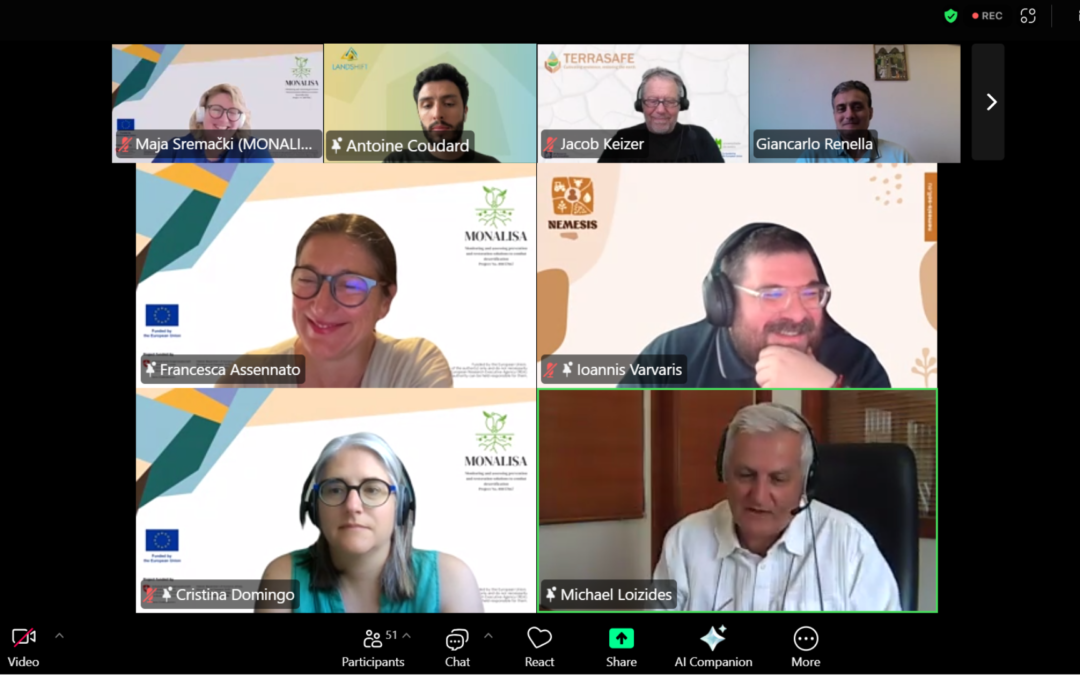
On 17 June, which marked the World Day to Combat Desertification and Drought, six Horizon Europe projects from the AgroTech Hub Cluster came together for a joint webinar Recognize. Respect. Restore. From Soil Degradation and Desertification to Resilient Land Systems. This session was dedicated to exploring practical approaches for restoring degraded lands, strengthening soil health, and building more resilient land systems.
The webinar was organised around two sessions. The first session, “Recognize & Respect” featured presentations from project representatives working on projects developing and testing solutions to combating soil degradation and desertification across Europe, the Mediterranean, and Africa. The webinar featured a diverse array of projects, including TERRASAFE, MONALISA, LandShift, Nemesis, AfroGrow and EARTHONE. While each project approached these challenges from a different perspective, a common message emerged throughout the event: restoring land requires integrated solutions that acknowledge the interconnectedness of ecological, social, and economic systems.
Turning local organic resources into soil restoration opportunities
The first presentation by Michael I. Loizides (Isotech) representing TERRASAFE, focused on overcoming the practical barriers that prevent compost from reaching agricultural soils at scale, particularly in dryland regions. The presentation explained how both centralized composting facilities and individual on-farm composting often face economic, logistical, and technical challenges that limit adoption by farmers.
Addressing these issues, he introduced the concept of Community Compost Hubs and an open-source co-composting model that brings together farmers, local authorities, and other stakeholders to produce high-quality compost from locally available organic materials. The approach aims to reduce costs through shared infrastructure, local processing, and community ownership while simultaneously supporting soil carbon restoration, circular economy principles, and sustainable land management.
Locally adapted solutions for restoring Mediterranean drylands
Subsequently, Cristina Domingo-Marimon (CREAF) presented MONALISA‘s work on tackling land degradation and desertification in Mediterranean drylands through a range of locally adapted restoration and land management practices. The presentation showcased solutions such as sustainable grazing approaches, soil enhancement measures, conservation agriculture, ecosystem restoration, and innovative water management techniques, all aimed at supporting resilient landscapes while responding to local environmental and socio-economic conditions.
The LandShift NBS Library: a practical guide to Nature-Based Solutions for soil restoration
LandShift was represented by Antoine Coudard (Metabolic), who presented the LandShift Nature-based Solutions Library, guiding participants through the structure and navigation of the library, and showcasing how users can explore different Nature-based Solutions and assess their suitability for specific contexts. Antoine also highlighted the significant potential of Nature-Based Solutions to generate environmental, social, and economic co-benefits, positioning them as a key approach for advancing integrated and sustainable soil restoration efforts. His presentation also highlighted how the library integrates New European Bauhaus (NEB) principles and serves as a practical resource for LandShift’s Living Spaces and other stakeholders seeking to implement locally adapted and socially embedded soil restoration measures.
Scaling soil health solutions through collaborative Living Labs
Ioannis Varvaris (Eratosthenes Centre of Excellence) presented the NEMESIS project, which is establishing a network of Soil Health Living Labs across the Mediterranean to address desertification and soil degradation. His presentation highlighted the importance of co-creating solutions with farmers, researchers, policymakers, and local communities, recognising that soil health challenges differ across regions and require locally adapted responses. Through a combination of field testing, monitoring, digital tools, and knowledge exchange, NEMESIS aims to develop and scale effective solutions that strengthen soil health and resilience throughout the Mediterranean.
Restoring degraded landscapes through sustainable agroforestry
Representing AfroGrow, Zampela Pittaki (CIFOR-ICRAF) presented the project’s vision for advancing sustainable agroforestry systems as a pathway to restoring degraded land and improving soil health across Africa. The presentation highlighted how AfroGrow combines innovative monitoring technologies, digital tools, and stakeholder engagement to generate evidence on the contribution of agroforestry to land restoration and climate adaptation. By linking scientific knowledge with local experience, the project aims to support the wider adoption of agroforestry practices that can help reverse land degradation while delivering long-term environmental and socio-economic benefits.
Data-driven insights for resilient land systems
Finally, representing EARTHONE, Giancarlo Renella’s (University of Padova) presentation showcased how the project combines information from environmental sensors, soil monitoring systems, vegetation observations, and European data repositories to better understand the interactions between land management practices and climate-related processes. By analysing impacts on carbon storage, greenhouse gas dynamics, and ecosystem functioning, EARTHONE seeks to provide evidence that can guide adaptation strategies and promote more resilient agricultural landscapes.
Advancing soil restoration through embedded and integrated solutions
Despite their different geographical focuses and methodological approaches, all presentations highlighted the importance of combining scientific innovation with locally grounded action to address soil degradation and build more resilient land systems. Whether through Nature-based Solutions, agroforestry, composting initiatives, Living Labs, or data-driven monitoring and decision-making, the presentations demonstrated that effective land restoration requires collaboration across sectors, disciplines, and stakeholder groups. A recurring message throughout the webinar was that restoring soil health is not only an environmental necessity, but also a critical foundation for climate resilience, biodiversity conservation, sustainable food systems, and rural livelihoods.
Watch the full webinar here.