
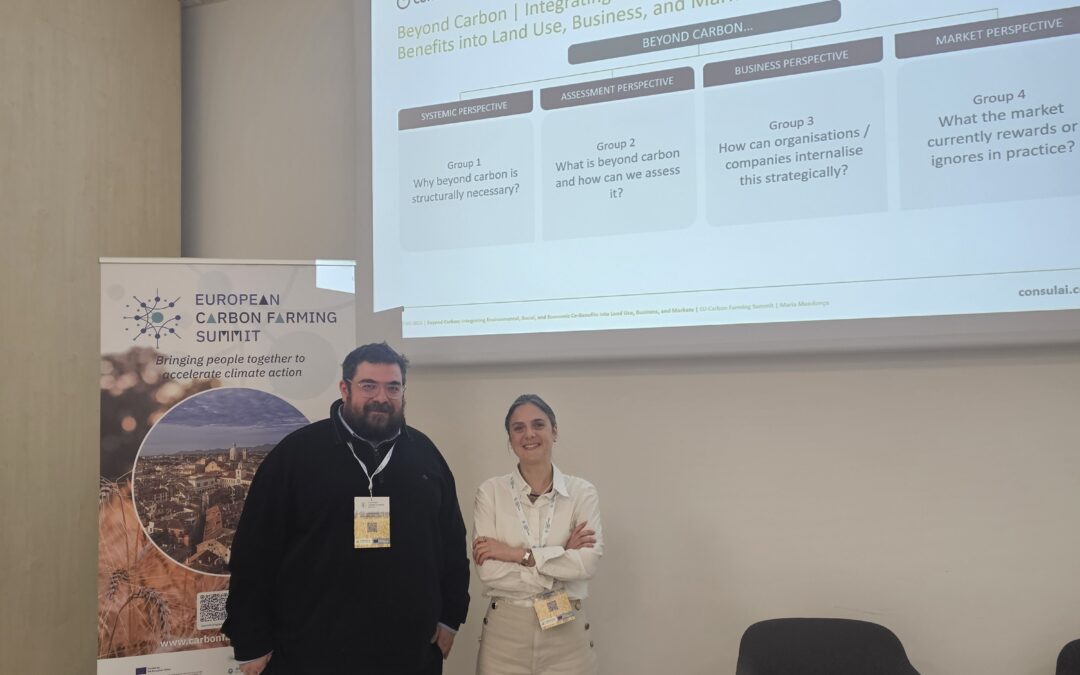
On 18 March, LandShift was represented at the EU Carbon Farming Summit in Padova, Italy, by Ioannis Varvaris, Scientific Coordinator of LandShift, based at the ERATOSTHENES Centre of Excellence (ECoE) which is coordinating LandShift, and Francesca Piatto from the consortium partner European Association of Remote Sensing Companies (EARSC).
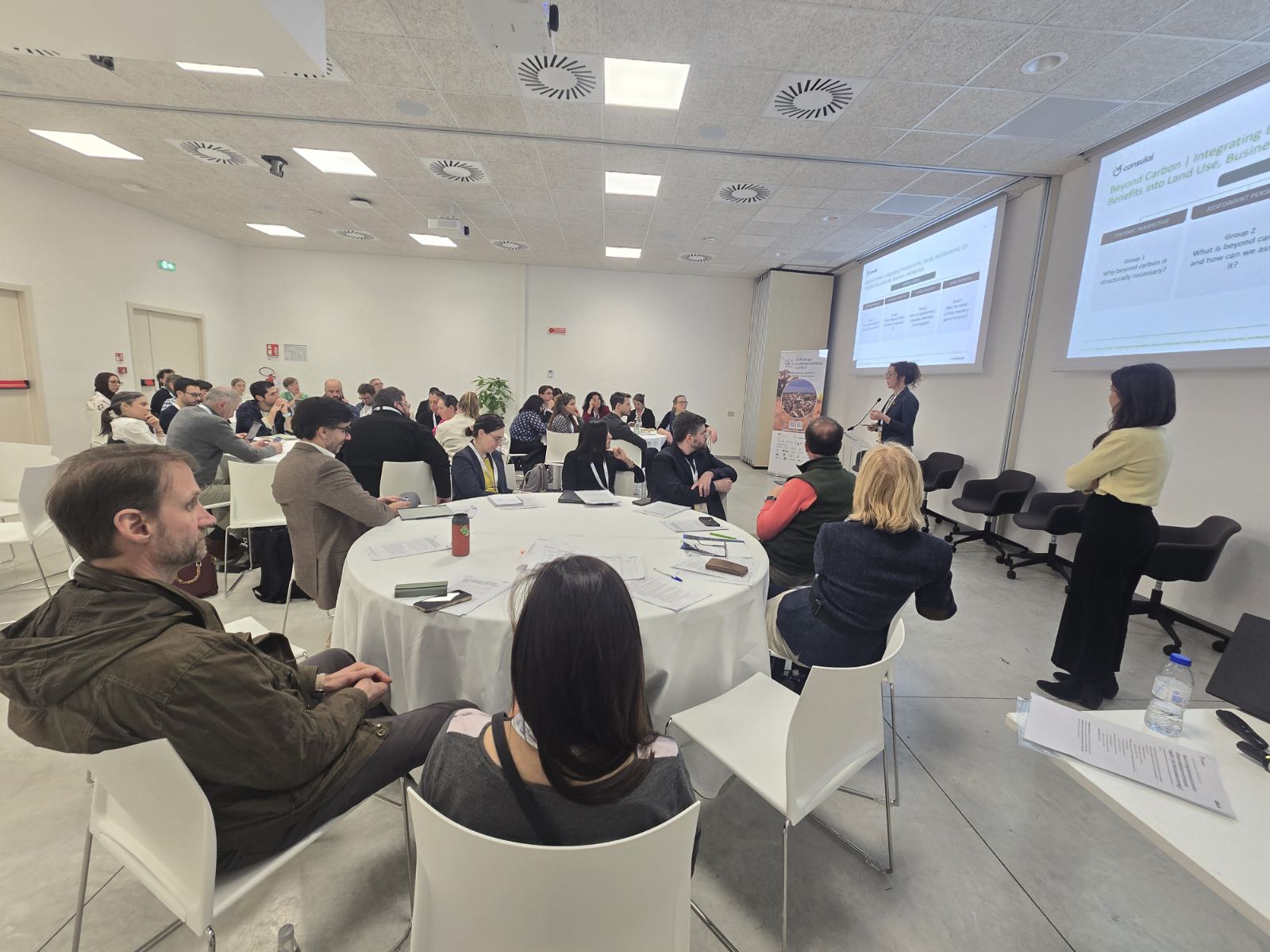
LandShift, in collaboration with the agribusiness consultancy CONSULAI co-organised the workshop “Beyond Carbon: Integrating Environmental, Social, and Economic Co-Benefits into Land Use, Business, and Markets.” The session aimed to explore how the transition toward climate-neutral and resilient land-use systems can move beyond a carbon-centric approach by explicitly integrating environmental, social, and economic co-benefits into land management practices and land-use strategies. It brought together perspectives from governance, community-based approaches, farm and business strategies, MRV frameworks, and market development to examine how co-benefits can support soil health, biodiversity conservation, climate adaptation, social value creation, and long-term economic viability.
Discussions highlighted that carbon sequestration in inherently linked to soil health, the protection of biodiversity, soil health, and socio-economic development. Thus, these factors were identified as co-benefits that are crucial to ensure long-term climate resilience.
From Farm-level Practices to Comprehensive Strategies
Participants discussed how these priorities could be translated into concrete actions. Particularly, it was discussed how carbon farming can evolve from individual practices at farm level into integrated land-use strategies at broader levels. What is needed to do so is:
- Drawing on Nature-based Solutions (NbS) and Living Lab approaches as key implementation pathways.
- Strong cooperation across stakeholders.
- Linking farm-level MRV systems to regional strategies.
- Expanding MRV to include sustainability and social dimensions.
The importance of long-term monitoring, stable governance structures, adequate funding, and community acceptance was also strongly emphasised. The discussion also underscored the importance of evolving policy frameworks and standards to move beyond a sole focus on carbon, and instead reward comprehensive co-benefit bundles. This includes better integration of biodiversity and ecosystem service indicators into frameworks such as the Carbon Removal Certification Framework (CRCF). Overall, the session demonstrated that achieving impact “beyond carbon” requires strong alignment between policy, business strategies, MRV systems, and financing mechanisms, supported by local experimentation and long-term commitment.
What LandShift can offer
LandShift contributes to this vision by developing decision-support tools, translating complex co-benefits into actionable implementation roadmaps by making them measurable, comparable, and investable. In so doing, LandShift plays a crucial role in positioning carbon farming as part of a broader systemic transformation towards more sustainable, resilient, and inclusive land-use practices across Europe.
PRESS CONTACT
For more information, press materials, or interview requests, please contact:
White Research
Dissemination & Communication Manager,
Nikolaos Sotiriou: [email protected]
Eva Steinhorst: [email protected]