
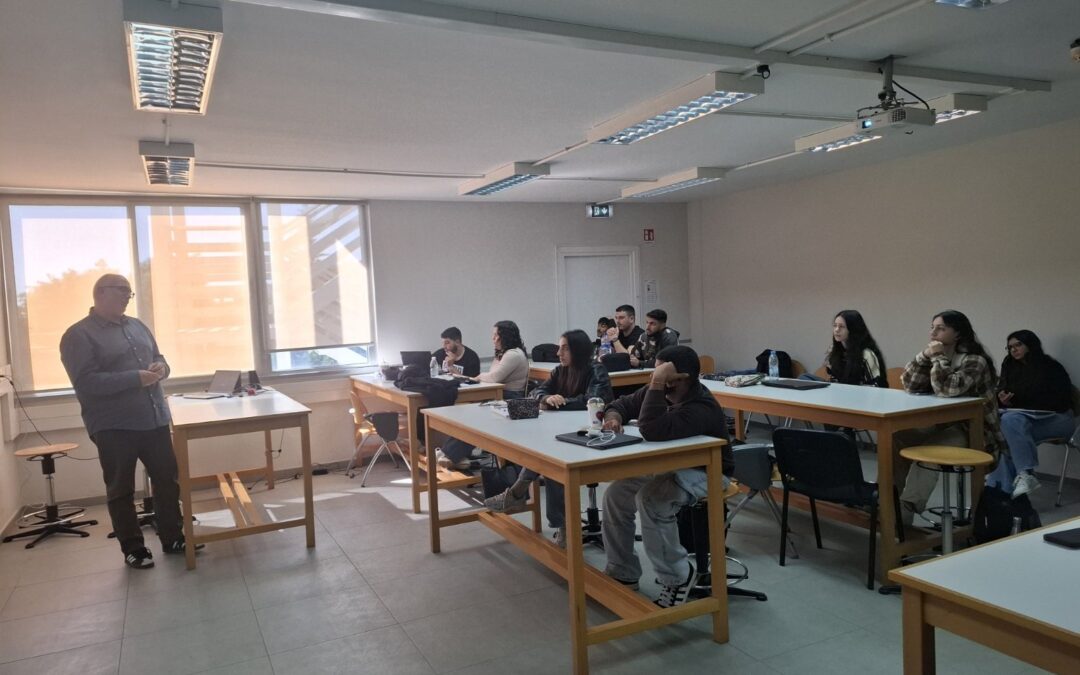
On Thursday the 19th of February, Dimitris Koumoulidis, Assistant Researcher at the ERATOSTHENES Centre of Excellence which coordinates LandShift, gave a lecture to students of the Department of Civil Engineering and Geomatics at the Cyprus University of Technology as part of their course on Spatial Planning.
The session revolved around the New European Bauhaus (NEB) and its relevance for spatial development, sustainability, and inclusive planning. The NEB is a policy and funding initiative launched by the European Commission in 2020, with the goal to make the green transition attractive, inclusive and sustainable while respecting the diverse cultural and geographic landscapes in Europe and beyond. The NEB is rooted within the original Bauhaus movement centred around functional beauty and social purpose, whilst introducing ecological sustainability as an essential new component. It is a vision for social transformation which is expected to be implemented in a number of different sectors including spatial and urban planning, construction and architecture, design, agriculture and environmental conservation as well as various others.

The lecture took a close look at the case of Cyprus, which is confronted with significant challenges specifically in relation to land use and land cover modification, urban sprawl, and climate pressures which underscores the importance for unified, data-centric territorial planning – a topic which Dimitrios has already written about in various scientific publications. More centralised data can improve the management of infrastructure and resources, as well as support climate change adaptation and mitigation strategies.
As part of the lecture, Dimitrios also took the opportunity to introduce LandShift, as a project that is rooted in the principles of the New European Bauhaus and which collects environmental observation data while also introducing new tools that help make existing data and research accessible and integrate it into useful formulas aligned with land-use decision-making priorities. Dimitrios, alongside Landshift’s scientific coordinator Ioannis Varvaris and a number of other researchers, have already published Research Paper within the framework of the project, examining the legislative structures shaping land-use in the project’s five Use Cases. The study analyses patterns, barriers and opportunities of current legal frameworks.
What is unique about LandShift, is its approach that pays strong attention to the contextual realities within the Living Spaces it operates in. Beyond EU level climate objectives, it integrates regional, national and local objectives. That being said, LandShift is not only a so-called Lighthouse case demonstrating what it takes in practice to integrate the NEB principles, it also provides a relevant case study for students of spatial planning. As climate pressures intensify, future spatial planners will need to be interdisciplinary and innovative thinkers, mediating between scientific data, complex regulatory frameworks, policy, as well as governance processes.
PRESS CONTACT
For more information, press materials, or interview requests, please contact:
White Research
Dissemination & Communication Manager,
Nikolaos Sotiriou: [email protected]
Eva Steinhorst: [email protected]