

MAY 20, Brussels – The LandShift project was present at the CarbonFarm Med project’s event “Carbon Farming MED: Advancing Policy, MRV, and Action” in Brussels. A rundown of the event and a link to the LandShift project are presented below.
At first, there was an introduction to the Dehasa systems in Spain by the European Agroforestry Federation and hosts of the event, EURAF. These are systems located in the Extremadura region of Spain, where there is the sustainable exploitation of extensive livestock farming, but that is also used as a tool for conservation and improvement, rather than strict exploitation. They also have widespread environmental and socio-economic benefits to local livelihoods. They are perceived very favourably by the European Union.
Afterwards, carbon farming policies and linkages were discussed by high level EC representatives from Valeria Forlin, Deputy Head of Unit, Low Carbon Solutions (DG Clima) – Land Economy & Carbon Removals on the carbon removal certification framework as well as Gregorio Dávila Díaz, Deputy Head of Unit for Environmental Sustainability (DG Agri) on agroforestry and carbon farming in the CAP, respectively.

Following this, the role of research projects in delivering credible carbon farming in the EU was highlighted by Tristano Bacchetti De Gregoris, Founder & Head of Research & Innovation, SAE Innova as well as the role that Monitoring, Reporting, and Verification play in agroforestry, and its resulting challenges were presented. This was done by Gerry Lawson, policy advisor at EURAF.


Next, the Carbon Farming Med project was presented in detailed by WP leaders from Spain, Italy, Slovenia, and the EU, highlighting the role of the project and showcasing the carbon credits platform of the project, which is the key output of the project.
Finally, a panel discussion between representatives of private landowners (Ana Rocha, European Landowners’ Organization), farmers’ unions (Irene de Tovar Hernández from Copa-Cogeca and a representative of the Spanish Farmers’ Union), NGOs (Hannah Winkler from IFOAM Organics Europe), and researchers (Carlos Torres Guerrero from BETA Technological Centre) presented various perspectives of the topic of carbon farming and the way to move forward. More info on the event can be found here.
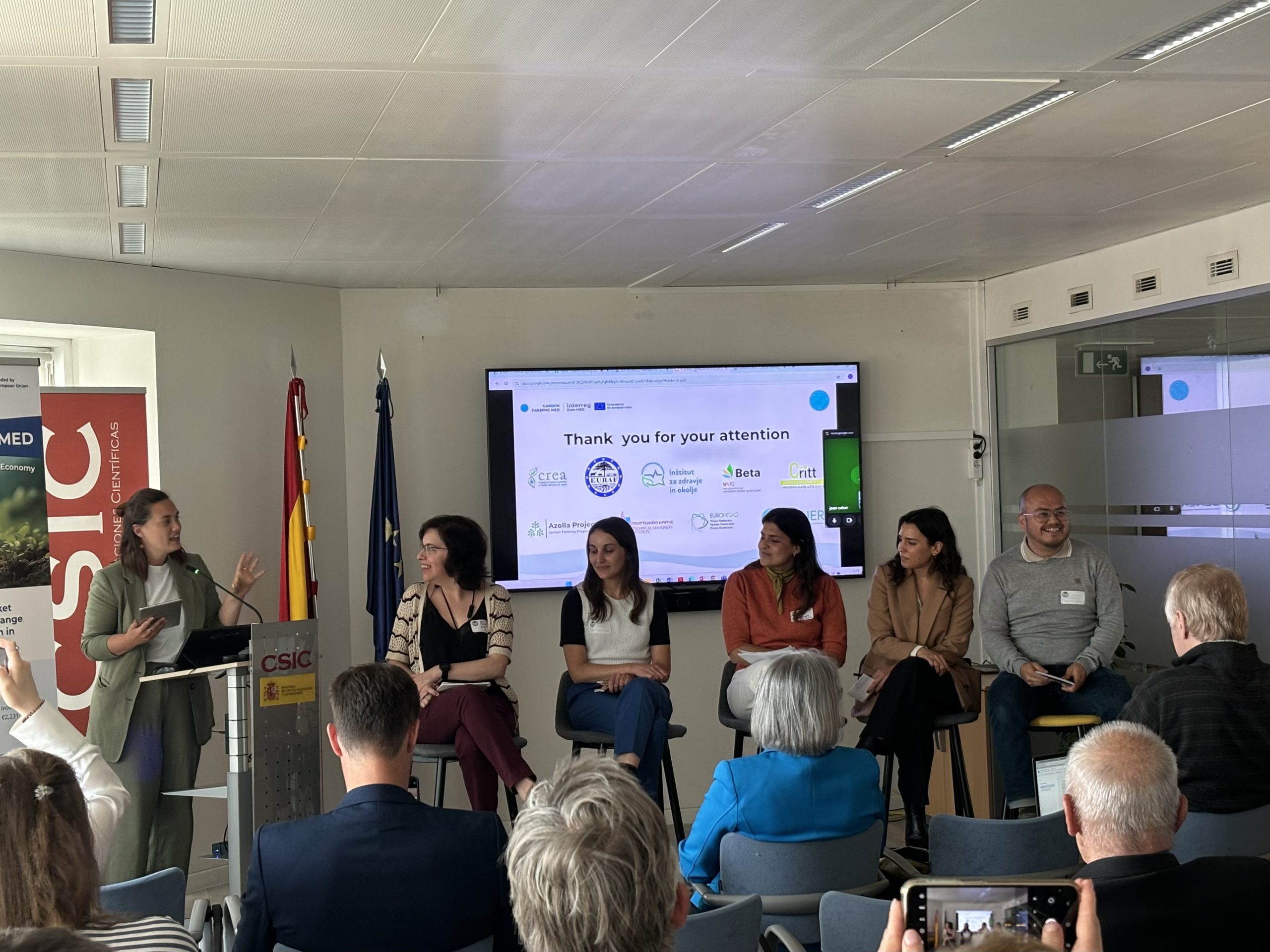
The event was an excellent opportunity to learn more about agroforestry and the benefits it has on a local/regional scale as well as the impacts it can have on farming systems and surrounding ecosystems, yet also the role that agroforestry has on an EU-policy level and the type of direction that it will have in the near future.
This was complemented by the inputs of the Carbon Farming Med project, which very much highlighted its research and where it stands in laying the foundation for future activities, research, and policy action for the future. Nevertheless, challenges in lack of consistency in definitions of MRV were reminded and solutions presented to ensure that all actors would have the same grounding. The role that projects have in assisting in this was presented.
Finally, to provide a wider perspective, the different perspectives of landowners organisations, NGOs, farmers unions, and researchers were laid out, which are key to understand and take into account in order to collectively solve this approach.
The combined bottom-up and top-down approach of presenting agroforestry during this event very much laid the foundation for the upcoming work that needs to be done to foster a sustainable future in the context to maximise the uptake of carbon from the atmosphere whilst maintaining healthy environments at the intersection of environmental, social, and economic sustainability for all involved stakeholders.
From a LandShift perspective, it was interesting to learn about the carbon credits market, its political framework, as well as the complexities of MRVs and the challenges that they result in. The complexity of the current landscape was raised on multiple occasions, and the need to simplify for all stakeholders seemed to be a general consensus.
After the event, a networking lunch took place where attendees and speakers got together and discussed what was presented as well as how future collaborations can take place.
At LandShift, we very much welcome the opportunity for any synergies, as after all, only together can help shape a sustainable future.
PRESS CONTACT
For more information, press materials, or interview requests, please contact:
Nikolaos Sotiriou
Dissemination & Communication Manager,
White Research