
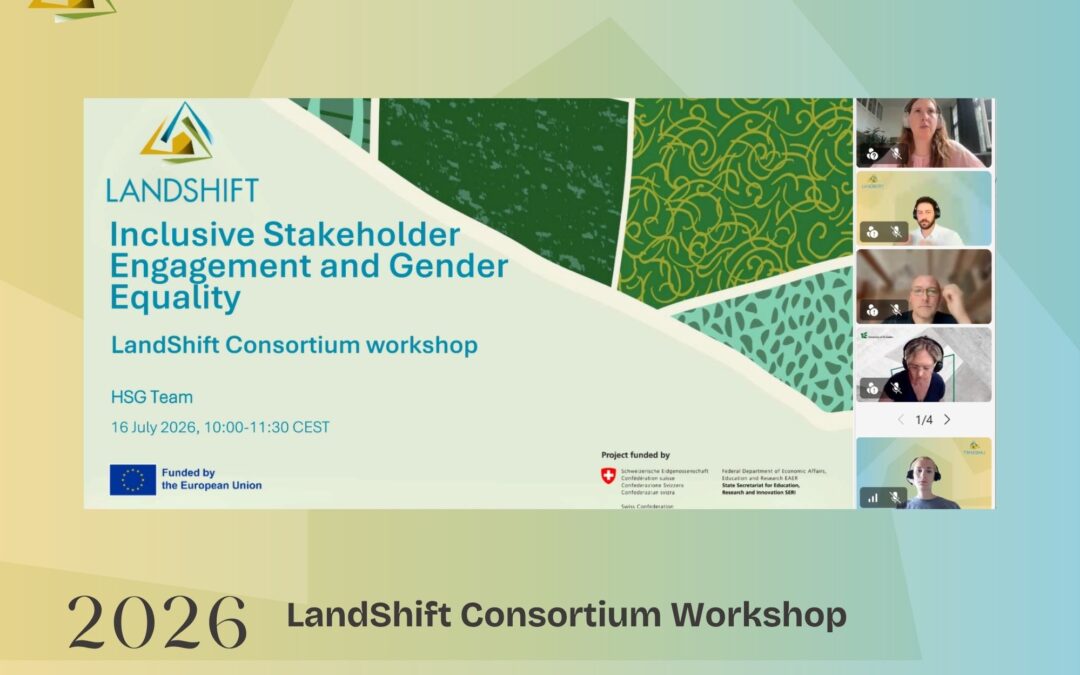
Today, LandShift partners from the University of St. Gallen organised a workshop on inclusive stakeholder engagement and gender equality. During this workshop, project partners came together to explore how to strengthen inclusive dialogue, and equitable participation in project programming and to reflect on how unconscious bias and power imbalances can surface in – and affect – stakeholder engagement. Through a combination of presentations, case studies, group discussions, and interactive exercises, participants examined realistic scenarios and explored practical strategies for recognising and addressing exclusion in professional settings.
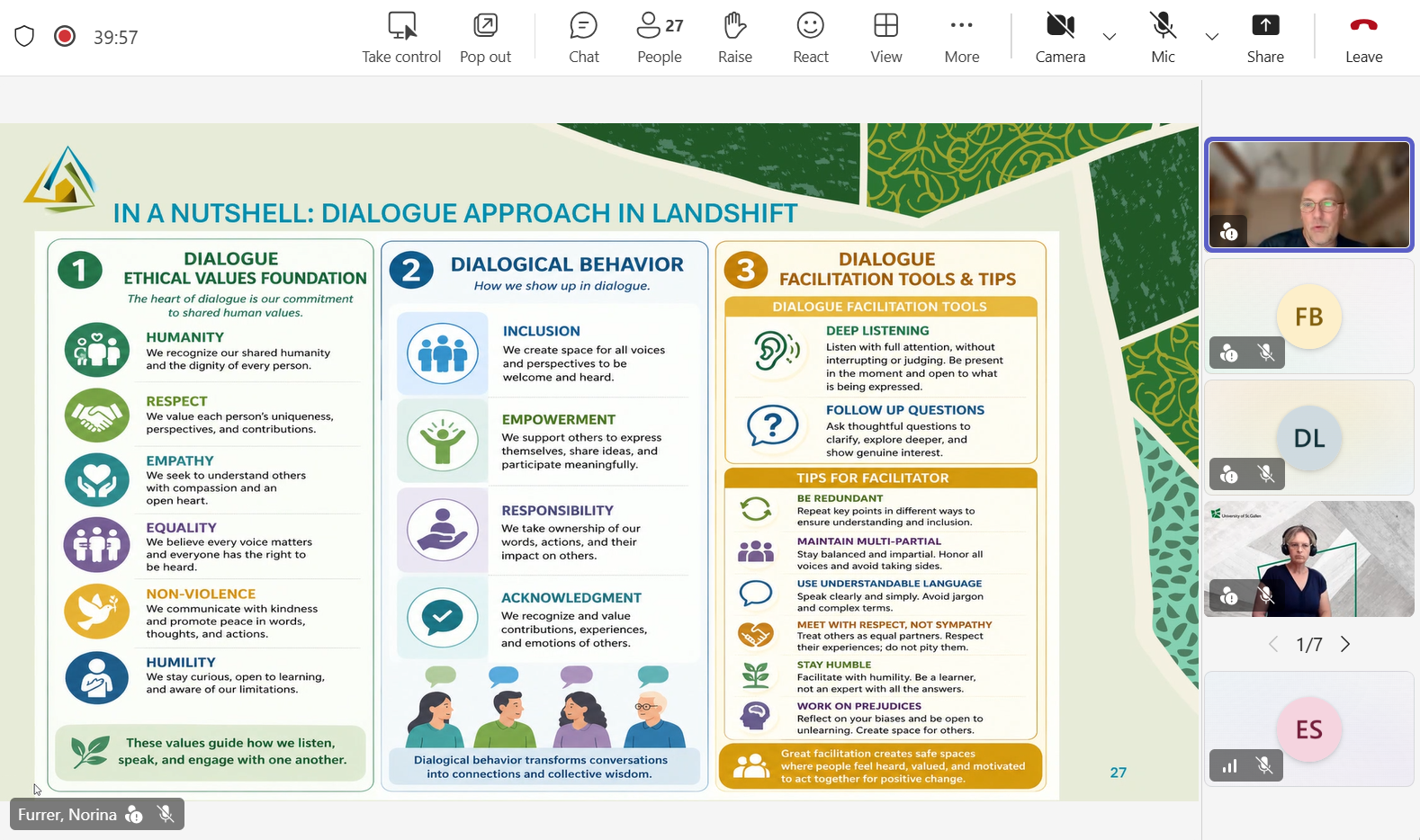
Recognising and Addressing Unconscious Bias and Unequal Power Structures
The workshop opened by highlighting that inclusion is not simply about ensuring representation, but that it is about ensuring that everyone has an equal opportunity to contribute and influence decisions. Participants explored how unconscious bias can affect participation in meetings, whose expertise is recognised, whose ideas are adopted, and ultimately the quality of project outcomes. The facilitators emphasised that small everyday decisions can either create inclusion or reinforce exclusion, making gender equality and stakeholder engagement responsibilities shared by everyone involved in a project.
One of the workshop’s central activities focused on a case study illustrating how unconscious bias can influence decision-making in meetings. Participants discussed practical ways to respond as colleagues, supervisors, and facilitators, emphasising the importance of recognising original contributions, creating space for quieter voices, and establishing meeting practices that promote equal participation.
Shared Responsibility for Inclusive Engagement
One of the core outcomes from the exercise was that everyone shares responsibility for inclusion in engagements. It starts with colleagues acknowledging overlooked ideas, the audience should actively listen to everyone, and moderators should facilitate equal participation.
Another core outcome from the exercises was to establish inclusive meeting rules from the beginning, preventing situations rather than reacting to them. This includes agreeing on participation rules, making clear that every contribution deserves consideration, and creating space for every participant to speak, e.g through allowing multiple ways to contribute though means such as written contributions.
Embedding Inclusion into Everyday Practices
The workshop concluded by encouraging participants to consider inclusion throughout the entire project cycle by asking simple but powerful questions: Who is missing from the discussion? Who has space to speak? What forms of knowledge are being recognised? These reflections reinforced that inclusive stakeholder engagement is not a separate activity, but an integral part of effective project planning, implementation, and decision-making.
PRESS CONTACT
For more information, press materials, or interview requests, please contact:
White Research
Dissemination & Communication Manager,
Nikolaos Sotiriou: [email protected]
Eva Steinhorst: [email protected]