

For three days earlier this year, from March 17th to 19th, the city of Paphos in Cyprus was host to the “Eleventh International Conference on Remote Sensing and Geoinformation of Environment” (RCSy2025). It was an essential event to network with leading experts from across Europe and the world in the field of remote sensing and geoinformation. Topics included 3D remote sensing, application to agriculture, earth observation, environment and climate, environmental monitoring and protection, and many more.
The LandShift project was proudly present at this event, and even co-organised the workshop on “Advancing Climate Action, Environmental Sustainability and Food Security through Synergies”. During the workshop, four partners from three partner organisations presented not only the project but also which elements of the project relate to the workshop as well as the conference as a whole.

Notably, coordinator Ioannis VARVARIS (Eratosthenes Centre of Excellence) presented the project, emphasising its integrated, transdisciplinary approach to sustainable land-use planning through co-creation with stakeholders, as well as the use of digital tools, and the implementation of Nature-Based Solutions that are aligned the New European Bauhaus principles.
Following this, fellow colleague from Eratosthenes, Dimitris KOUMOULIDIS presented his work on employing spatial queries in QGIS (an geographic information systems tool to make maps) in terms of identification and evaluation of potential sites for forest nurseries installation in the Limassol region of Cyprus. During his presentation, he actively demonstrated practical applications of geospatial tools such as QGIS in environmental planning, supporting reforestation, and landscape regeneration at the local level.


Representing our Italian partners from the Politecnico di Milano, M. GABRIELE contributed to the workshop by presenting on the implementation of the land use, land use change, and forestry framework (LULUCF – see Glossary) monitoring platforms in the context of the agriculture, forestry, and other land-use (AFOLU) sector and regenerative agriculture. She very much highlighted the potential of advanced monitoring systems to support climate mitigation and land restoration efforts within the land-use sector.
Finally, from the Interbalkan Environment Center, Dr. Paraskevi CHANTZI dived deep into the world of machine learning algorithms during the workshop, more specifically how they can be applied to multitemporal Sentinel-2 (a European Space Agency satellite used specifically to map changes in land cover and to monitor the world’s forests) imagery to significantly enhance land use classification accuracy. This in turn would support improved environmental monitoring and sustainable land management practices.
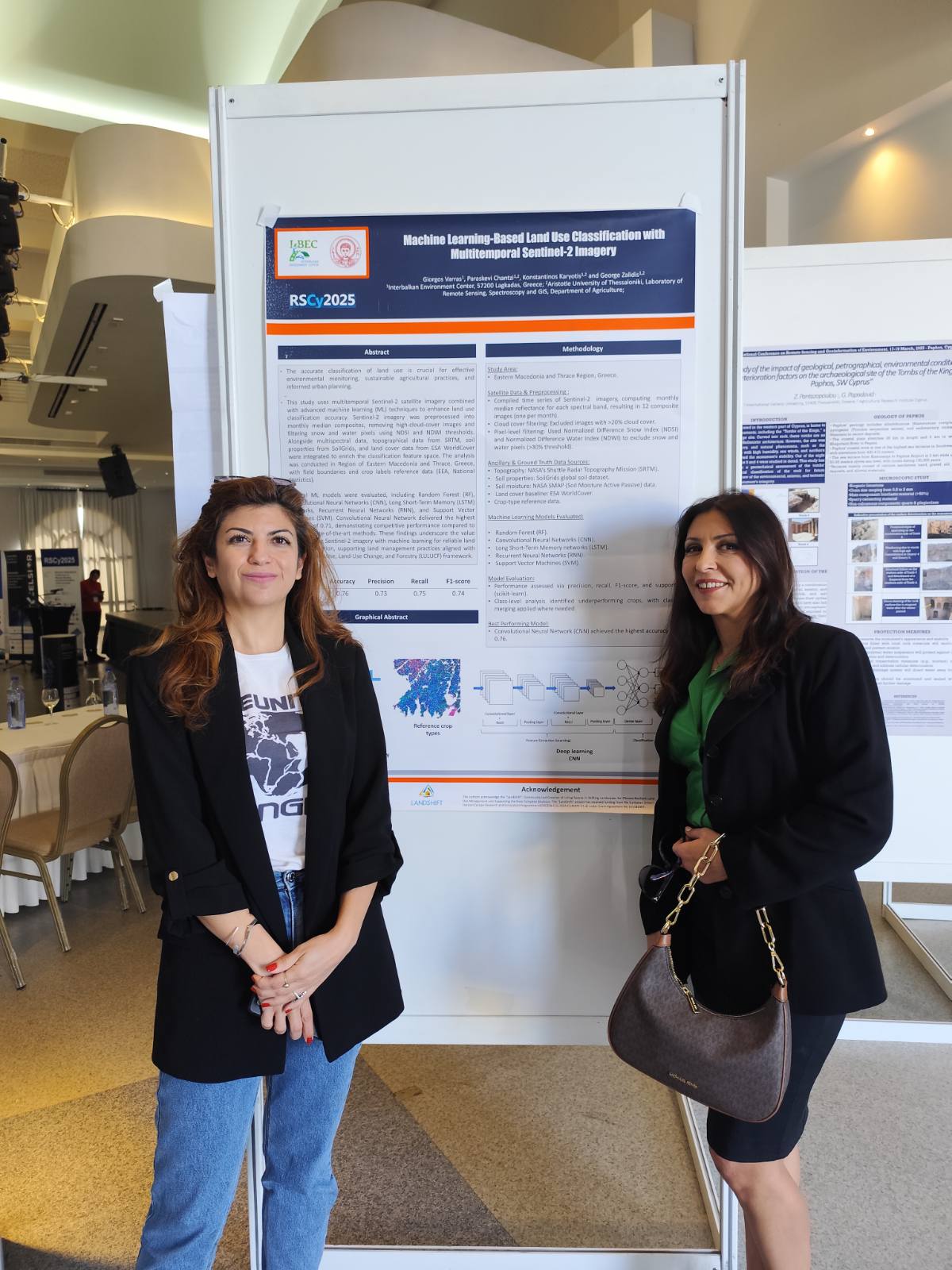
One of the key aspects of attending such events is also to engage in fruitful discussions with other projects and participants present to learn more about other research but also examine the possibilities of future synergies together. The LandShift team present at RCSy2025 did just this, specifically with fellow attendees working on the topics of land-use monitoring, ecosystem restoration, and climate-resilient development. Engaging in such synergies further solidified the LandShift project’s position within the broader network of initiatives tackling land degradation, biodiversity loss, and climate adaptation through collaborative innovation.
In the future, LandShift and LandShift partners will continue to attend and/or present in conferences/events related to the project, and lay the foundation for future synergies to come with a wide array of stakeholders.
For more information on the RSCy 2025 event, please take a look at the link here: https://rscy2025.com/