
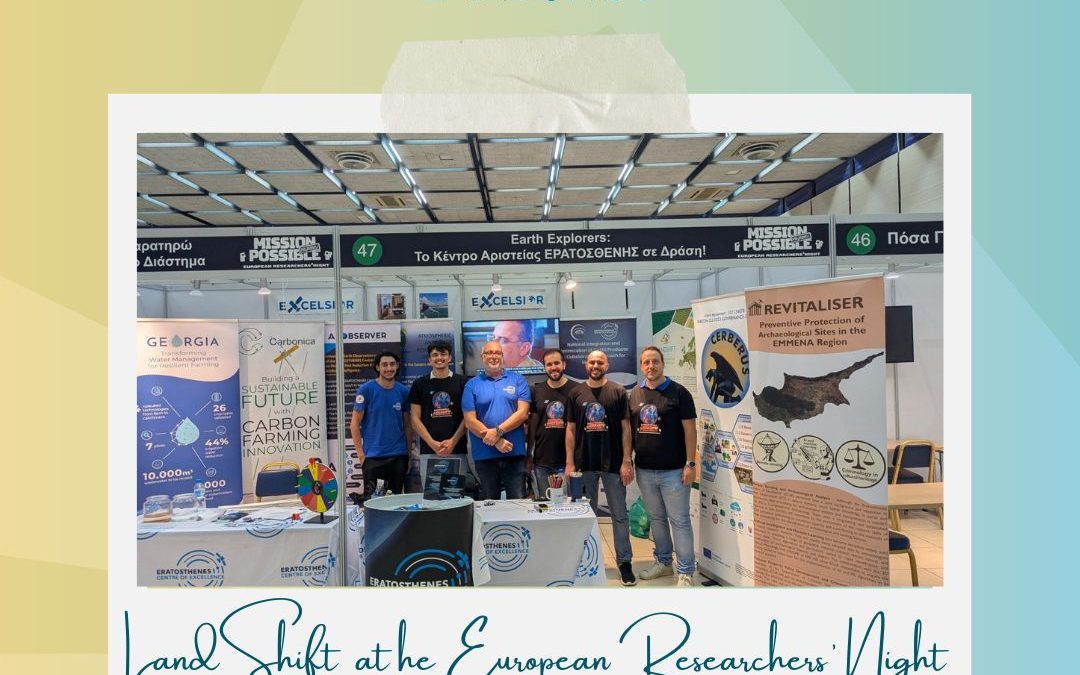
LandShift took centre stage at the European Researchers’ Night 2025 in Cyprus, an annual flagship initiative organised by the Research and Innovation Foundation (RIF). The event is part of a Europe-wide celebration dedicated to bringing science and innovation closer to citizens, with activities designed to inspire curiosity, connect research to everyday life, and highlight the role of science in shaping our shared future.
This year’s motto, “Mission Possible”, captured the spirit of the evening: addressing today’s global challenges with creativity, knowledge, and collaboration. Against this backdrop, LandShift was presented at the ERATOSTHENES Centre of Excellence (ECoE) booth, offering visitors an opportunity to learn how European research is paving new pathways for sustainable land use and climate resilience.
Introducing LandShift to the public
Representing the project, Dimitrios Koumoulides (MCIHort) engaged with citizens of all ages from students and young researchers to families and policymakers introducing LandShift as an EU-funded Horizon Europe project.
He explained that the project’s unique strength lies in its ability to bridge top-down policy needs with bottom-up community action, creating a balanced approach to land-use management that is both data-driven and people-centred. Visitors discovered how LandShift brings together advanced research, digital tools, and local participation to answer some of the most pressing land-use challenges of our time.
Five Living Spaces, five laboratories for change
A key highlight of the presentation was LandShift’s work across five Living Spaces:
-
🇫🇷 Occitanie (France)
-
🇬🇷 Eastern Macedonia and Thrace (Greece)
-
🇮🇹 Basilicata (Italy)
-
🇵🇱 Mazowieckie (Poland)
-
🇺🇦 Kyiv Region (Ukraine)


Each Living Space acts as a real-world laboratory, where stakeholders and local communities come together to co-develop strategies for:
-
🌱 Improving soil health
-
🦋 Conserving biodiversity
-
💧 Managing freshwater resources
-
🌍 Achieving balanced land-use trade-offs
Through these collaborative spaces, LandShift ensures that solutions are not imposed from the outside but co-created with those who are directly affected. This approach fosters both trust and long-term sustainability.
Science, technology, and communities working together
Visitors to the booth also learned about the role of AI and scenario analysis in the project. These digital tools allow researchers and policymakers to test different land-use options, compare outcomes, and design future strategies that are resilient and adaptable.
At the same time, Dimitrios emphasised that LandShift is not only about science and technology it is also about people. By embedding stakeholder engagement and co-governance at the core of its methodology, LandShift ensures that local priorities, cultural contexts, and social realities are always respected.
This people-first approach is further strengthened by the project’s commitment to the principles of the New European Bauhaus designing land management solutions that are environmentally sustainable, socially inclusive, and culturally meaningful.
Mission Possible: a shared European pathway
In the lively atmosphere of European Researchers’ Night, LandShift demonstrated how research can become a catalyst for real-world transformation. The project’s vision of resilient landscapes, sustainable food systems, and inclusive communities resonated strongly with the theme “Mission Possible.”
By bridging policies with communities, and science with society, LandShift is contributing to a shared European pathway towards climate-resilient land use, aligning environmental needs with human aspirations.
🔗 Learn more about European Researchers’ Night in Cyprus:
🔗 Explore LandShift: landshift.eu
PRESS CONTACT
For more information, press materials, or interview requests, please contact:
Nikolaos Sotiriou
Dissemination & Communication Manager,
White Research